




Maximizing Grammar Learning – A Guide to Selecting and Using Grammar Books
- Rolando Ponce De Leon Osuna

- 3 feb
- 4 min de lectura
A grammar book is not merely a rulebook to be memorized; it is a tool for developing
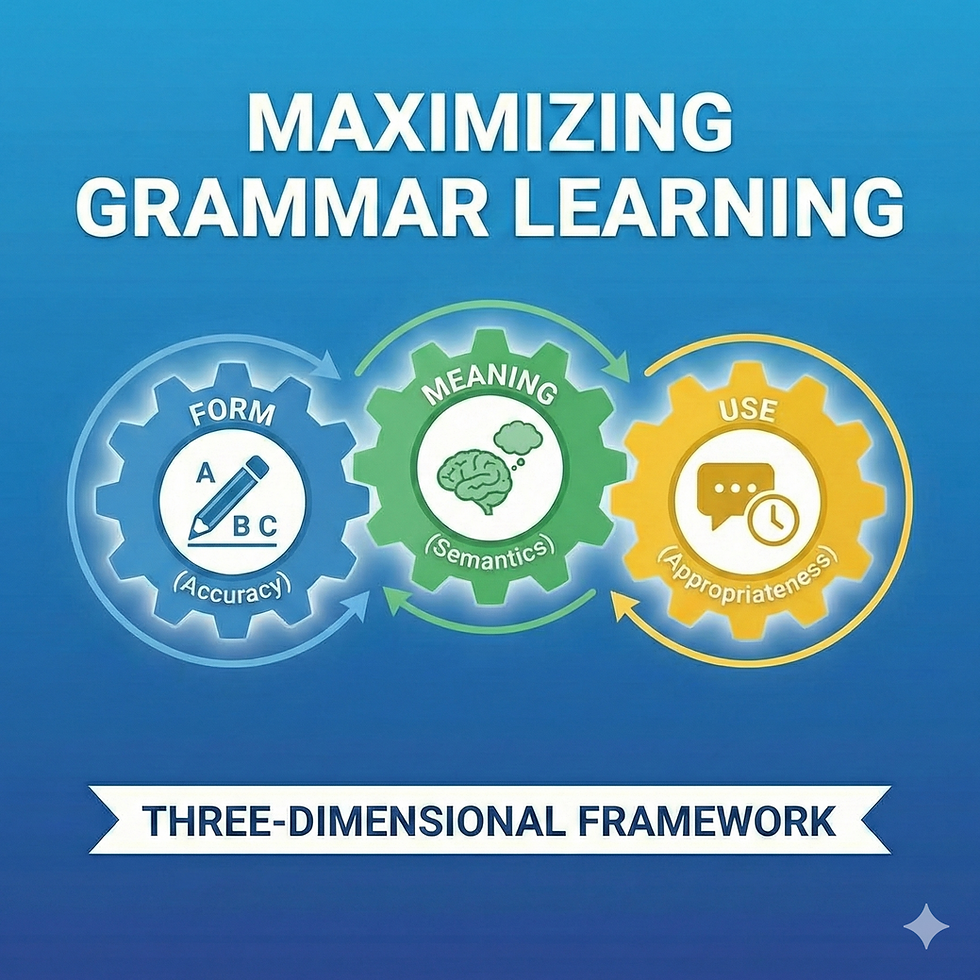
"grammaring"—the dynamic skill of using language accurately, meaningfully, and appropriately. For learners, the most effective approach involves selecting a text that matches their proficiency level and learning style (e.g., visual vs. text-heavy), distinguishing between reference and practice materials, and applying the "Three-Dimensional" framework of Form, Meaning, and Use.
1. Understanding the Three Dimensions of Grammar
Before opening a book, learners must understand that grammar is not just about avoiding mistakes. According to leading research, effective grammar mastery requires attention to three interconnected dimensions:
Form (Accuracy): How is the structure built? This involves spelling, pronunciation, and word order (morphosyntax).
Meaning (Semantics): What does it mean? This covers the literal concept conveyed by the structure (e.g., a conditional sentence expresses a condition and a result).
Use (Appropriateness): When and why is it used? This is the pragmatic dimension—knowing when to use a formal structure versus a casual one, or why a speaker chooses passive voice over active voice in a specific social context.
***Tip for Learners: When studying a new rule, do not stop at "what's the pattern / formula." Ask yourself: In what social situation would I actually say this?.
2. Selecting the Right Grammar Book
There is no single "best" book; the right choice depends on the learner's goals (self-study vs. classroom) and level.
For Self-Study and Practice
Raymond Murphy’s Series "In Use": Widely considered the gold standard for self-study.
Why it works: It uses a modular format where the left-hand page explains the rule (often with timelines and visuals) and the right-hand page provides exercises. It does not force students to go in order; they can dip in and out based on their needs.
Versions: Essential Grammar in Use (Elementary), English Grammar in Use (Intermediate), and Advanced Grammar in Use.
Betty Azar’s Series: A classic North American text known for its grammar charts.
Why it works: It offers comprehensive tables followed by extensive practice. It is excellent for students who want explicit instruction and structural clarity.
English for Everyone (DK Publishing):
Why it works: Highly visual. It uses infographics and clean layouts, making it ideal for visual learners who find traditional text-heavy explanations intimidating.
For Quick Reference and Problem Solving
Michael Swan’s "Practical English Usage":
Why it works: This is not a coursebook but a problem-solver. It is organized alphabetically and addresses specific tricky points (such as the difference between "bring" and "take"). It is best for intermediate to advanced learners who have specific questions.
For Academic and Advanced Contexts
Grammar Dimensions:
Why it works: It is explicitly designed around the Form, Meaning, and Use framework, helping advanced learners understand the nuance of why certain structures are used in professional or academic writing.
3. Strategies for Using a Grammar Book Effectively
Owning the book is not enough; using it strategically is key to avoiding burnout and ensuring retention.
Do Not Read from Cover to Cover
Use the Index: Treat the book as a reference tool. If you are unsure about a specific rule (such as the "Oxford comma" or "past perfect"), look it up in the index rather than reading the book sequentially.
Diagnostic Approach: Many books, like the Grammar in Use series, include a diagnostic test. Take the test first to identify your weak points, then study only those units.
The "Notice and Check" Method
Read Theory First: Do not attempt exercises until you have read the explanation and understood the rule.
Check Answers Immediately: Use books that include an answer key. Complete an exercise and check it immediately to prevent reinforcing errors.
Consult the Glossary: Many books include a glossary of terms. If you don't know what "gerund" or "appositive" means, look it up to clarify the explanation.
Contextualize the Rules
Personalize Examples: Book examples can be generic. Try to rewrite them using people or places you know. For example, change "Can you tell me where the bank is?" to "Can you tell me where [your local supermarket] is?"
Hunt for Grammar: After studying a rule (e.g., passive voice), try to find it in authentic materials like such as news articles, movie trailers, or songs. This connects the form you studied to real-world use.
Inductive Learning (The Discovery Method)
Look at Examples First: Instead of reading the rule immediately, look at the example sentences provided in the chart or text. Try to figure out the pattern or rule yourself before reading the explanation. This cognitive effort often leads to better retention.
4. Common Pitfalls to Avoid
The "Fluency vs. Accuracy" Trap: Do not obsess over grammatical perfection. While accuracy is important, focusing too much on mechanics can hinder fluency. Remember that grammar is a resource for communication, not just a set of rules to be obeyed.
Ignoring the "Use" Dimension: Students often learn the form (how to build a sentence) but fail to learn the use (when to say it). For example, knowing how to form the present perfect is useless if you don't know that it connects the past to the present. Ensure your book explains when to use a tense, not just how to conjugate it.
Relying Solely on the Book: A book cannot correct your speaking. Supplement grammar study with resources that show grammar in context, such as graded readers or language learning apps that use video content.
5. Summary Checklist for Learners
Step | Action |
1 | Identify your level. Beginner? Go for Essential Grammar in Use. Advanced? Try Practical English Usage for reference. |
2 | Choose your style. Do you prefer charts (Azar), visuals (English for Everyone), or bite-sized modules (Murphy)? |
3 | Use the index. Don't read chapter 1 unless you need it. Go straight to your problem areas. |
4 | Connect to real life. Rewrite exercises with true sentences about your life. |
5 | Focus on Use. Always ask: "In what situation would a native speaker actually use this?" |


Comentarios